
The planet we live in belongs to a large group of planets we call as the Solar System. This planetary system in turn belongs to a much larger network of stars, planets, and cosmic bodies known as the Milky Way Galaxy. How much do we know about the galaxy we live in? Here are some fun and quick facts about the Milky Way Galaxy.
- The Milky Way is a spiral galaxy containing 200-400 billion stars and at least 50 billion planets. New data suggests that there may be up to twice as many free-floating planets in the Milky Way as there are stars.
- The name “Milky Way” is from the Latin Via Lactea, in turn translated from the Greek word Galaxias, referring to the pale band of light formed by stars as seen from Earth.

- The stellar disk of the Milky Way is approximately 100,000 light-years or 9x10¹⁷ km in diameter. The Solar System is very small compared to the Milky Way. If the Solar System were as big as the size of a US quarter, approximately one inch in diameter, the Milky Way would be the size of New England or France. That is how insignificant the size of the Solar System is compared to the Milky Way.
- The Milky Way could be as old as the Universe itself. In 2007, a star in its Galactic halo, called HE 1523-0901, was estimated to be about 13.2 billion years old, nearly as old as the Universe. The star is the oldest known object in the Milky Way.
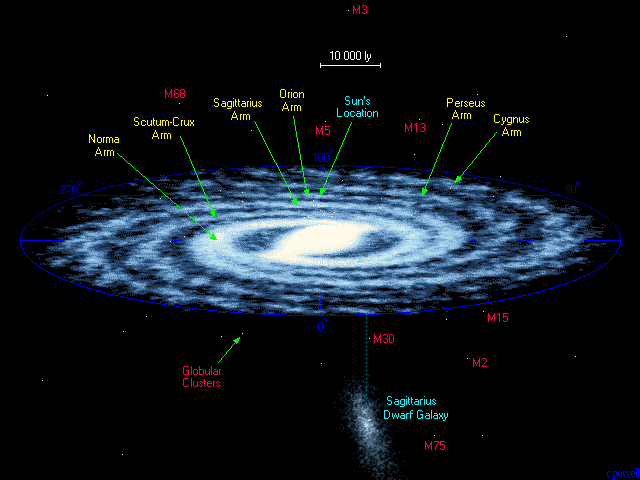
- The Milky Way is actually a barred spiral galaxy, meaning that the galaxy’s central bar is larger than previously assumed. Specifically, it is consists of a bar-shaped core region surrounded by a disk of gas, dust, and stars forming four distinct arm structures spiraling outward in a logarithmic spiral shape.
- The Sun and the Solar System is found in the galactic habitable zone, close to the inner rim of the galaxy’s Orion Arm. It travels through space in the Milky Way in the direction of the Apex of the Sun’s Way or the solar apex. Its motion is towards the star Vega near the constellation of Hercules, at an angle of roughly 60 sky degrees to the direction of the Galactic Center. The Sun’s orbit around the galaxy is roughly elliptical, and in addition, the Sun oscillated up and down relative to the galactic plane.
- The orbital speed of the Solar System about the center of the galaxy is approximately 220 km/s or 0.073% of the speed of light. At this speed, it takes around 1,400 years for the Solar System to travel a distance of 1 light-year, or 8 days to travel 1 AU (astronomical unit).
- There are many myths about the origin of the Milky Way. In Greek myths, the Milky Way was caused by milk spilt by Hera when suckling Heracles. In Sanskrit, the Milky Way is called as Akash Ganga, or Ganges of Heaven. It is considered to be sacred in Hindu, and the Ganges and the Milky Way are believed to be terrestrial-celestial analogs of each other.


