Showing posts with label Earth Science. Show all posts

Ten Major Advantages of Briquettes


Fuel has always been an indispensible need of man. Whether from developed or third world countries, people around the world need fuel for everyday living. In preparing our basic necessities like food and clean water, we need fuel. Usually, we rely on electricity and fossil fuel (like liquefied petroleum gas and kerosene) for our energy need.  Some nationalities use firewood and charcoal. However, there are other resources which have more advantages and benefits that these conventional sources. One such fuel is the briquette.

Briquettes are flammable blocks of matter used as fuel. They are made from extruded or compressed shredded combustible materials. A binding agent like starch may be necessary to hold the materials together, though pressure may at times be enough. Some of the common materials used as briquettes are charcoal fines, mineral char, sawdust, chaff from rice, peanut and other crops, peat, and any biomass materials.

So why do we have to used briquettes instead of firewood, charcoal, or electricity? What are their advantages over them? Well, here are ten of the major benefits derived from the utilization of briquettes as fuel.

1. Concentrated. Since briquettes are created from compressing combustible materials, they are denser, harder, and more compact. They have high specific density (1200kg/m3) and bulk density (800kg/m3) compared to 60 to 180 kg/m3 of loose bio mass. Thus, they offer a more concentrated form of energy than firewood or charcoal.

2. Slow-burning. The compression process allows the briquettes to burn for a lot longer than if it was loose in its original condition.

3. More efficient. Along with the compactness of the briquettes is the increase in heating value. Briquettes can relatively produce more intense heat than other fuel. They have a higher practical thermal value and much lower ash content (2-10% compare to 20-40% in coal). In fact, they are 40% more efficient, as well as hotter and longer lasting than firewood. This greater efficiency can be attributed to their low moisture and density.

4. Smokeless. This is a unique property of briquettes. Using them creates no smoke, soot, or carbon deposits. Depending on the base material, they produce no or little fly ash. Further, briquettes do not emit gases or any toxic chemicals like sulfur.

5. Availability. Biomass is the main component in producing briquettes. So where do we get this biomass? Look around you, and there are loads of biomass materials here, there, and everywhere.

6. Easy to make. There are presently commercial briquettes sold in the market. However, ordinary households can produce briquettes. You must only have a stock of combustible matter, a binder, and a molder to shape the briquettes.

7. Easily stored. The size and shape of briquettes make them easily be stored. We can readily pile them in several heaps because of their fun shapes like cubical, spherical, cylindrical, or rectangular blocks. They are likewise clean to handle and be packed into bags.

8. Easily transported. Compacting biomass waste into briquettes reduces the volume by 10 times, making it much easier to store and transport than loose biomass waste. Considering their shape, size, and density, briquettes are excellent for long distance transport. Likewise, loading and unloading cost are much less and are done easier.

9. Cheaper. Since briquettes can be domestically made from plants and animal wastes, they are consequently less expensive to produce, and thereby sold at lower prices.

10. Renewable. Briquettes make use of organic materials which are common and renewable. Hence, we are ensured of the sustainability of such fuel source.

“The Dead Sea Spits Out Asphalt” and Other Fun Facts about the Dead Sea


Bordering the countries of Jordan and Israel and the controversial West Bank, the Dead Sea is one of the most popular landlocked lakes in the world. This lake is known for its numerous unique characteristics. Here are some fun facts about the Dead Sea:

  • The Dead Sea is also known as the Salt Sea. Its Hebrew name is Yām ha-Melaḥ, meaning “sea of salt.”
  • The Dead Sea is the location of the Biblical cities of Sodom and Gomorra.
  • At 423 meters or 1,388 feet, the surface and shores of the Dead Sea is the lowest elevation on the Earth’s surface.
  • The Dead Sea is also the world’s deepest hypersaline lake at 377 meters or 1,237 feet deep.
  • Its salinity level is at 33.7%, making it one of the saltiest bodies of water in the world.  Other lakes like Lake Assal (Djibouti) and McMurdo Dry Valleys (Antarctica) have higher salinities than the Dead Sea.
  • The Dead Sea is named such because no animals can flourish in it. It is 8.6 times saltier than the ocean, and in this very harsh environment, animals cannot survive.
  • Only select quantities of bacteria and microbial fungi can live in its waters.
  • The mineral content of the Dead Sea differs from that of ocean water. There are around 14.4% calcium chloride, 4.4% potassium chloride, 50.8% magnesium chloride, and 30.4% sodium chloride. For most seas and oceans, sodium chloride is at 97% level.
  • Along the southwestern side of the lake is a 210 m (700 ft) tall halite (or salt) formation called "Mount Sodom".
  • The Dead Sea has a density of 1.24 kg/L, making swimming similar to floating. It is natural buoyancy that makes floating in the lake a lot easier.
  • The Jordan River is its only major water source. There are small springs under and around it which create pools and quicksand pits. The Dead Sea has no outlet streams.
  • During the winter, its water temperature tends to be higher than land temperature, and the reverse during the summer months. This is due to the water’s mass and specific heat capacity. On average, there are 192 days above 30OC or 86OF annually.
  • The Dead Sea constantly discharges asphalt, a feature very unusual to any lake. It spits up small pebbles of the black substance from its deep cracks. Asphalt coated figurines and bitumen coated Neolithic skulls from archaeological sites have been found. It is believed that this asphalt had been used to mummify Egyptians.
  • It is one of the world’s first health resorts, dedicated for Herod the Great.
  • The Dead Sea is a popular center for climatotherapy (treatment using climatic features like temperature, humidity, sunshine, and pressure), heliotherapy (treatment using the biological effect of the sun’s radiation) and thalassotherapy (treatment through bathing in the lake’s water). Specifically, it has treatment centers for psoriasis, rhinosinusitis, and osteoarthritis.
Read "The Dead Sea Spits Out Asphalt” and Other Fun Facts about the Dead Sea at Triond

Ten Marvelous Sea Cliffs in the World


Cliffs are near vertical rock exposures and formations. They are produced by the processes of erosion and weathering over time.  They are found on coasts, in mountainous areas, and along rivers. If found on sea, it is called as sea cliff.

A sea cliff is an erosional landform, produced by wave action, which is either at the seaward edge of the coast or at the landward side, and which denotes the inner limit of the beach erosion. They are created for millions of years, and this slow and creative process produced some of the world’s magnificent sites. Here are some ten of the world’s marvelous sea cliffs.

Cliffs  of Moher

Found near Doolin in County Clare, Ireland, the Cliffs of Moher rise 120 meters (394 ft) above the Atlantic Ocean at Hag’s Head. The cliffs consist mainly of beds of Namurian shale and sandstone. There are many animals living on the cliffs, including an estimated 30,000 birds. Due to its breath-taking beauty, the Cliffs of Mother rank as one of the most popular tourist destinations in Ireland and topped the list of attractions in 2006. In 2009, the Cliffs were named one of the 28 finalists in the “New Seven Wonders of Nature.” They have also appeared in several films like Leap Year (2010) and Harry Potter and the Half-Blood Prince (2009). (image source)


White Cliffs of Dover
Stretching east and west from the town of Dover in the British county of Kent, the White Cliffs of Dover rise 107 meters (351 ft) high. The cliff face can be seen across the English Channel from France. The cliffs are made of chalk (pure white calcium carbonate) accentuated by streaks of black flint. The chalk bed consists of remains of shells from microscopic creatures living on the seabed over 70 million years ago. Several cliff nesting birds nest on the cliff face, including fulmar and colonies of black-legged kittiwakes. (image source)


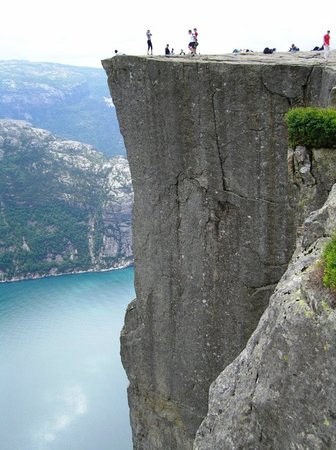
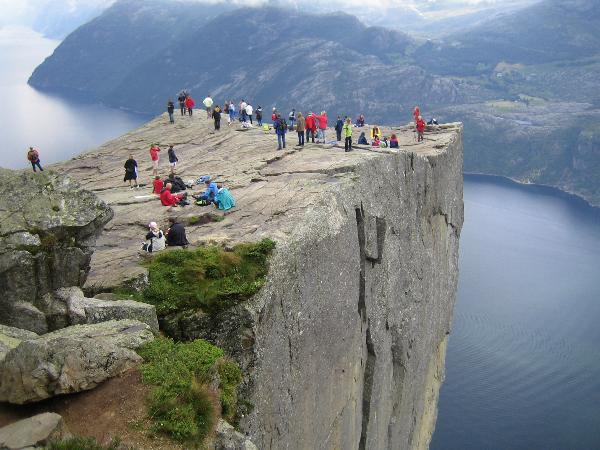
Preikestolen

Also known as Prekestolen, Preacher’s Pulpit, Pulpit Rock and locally as Hyvlatonna, the Preikestolen is a massive cliff above Lysefjorden in Forsand, Ryfylke, Norway. It is about 604 meters (1982 ft) high. A remarkable feature of the cliff is its almost flat top that measures approximately 25 by 25 meters square. It overlooks the dense and green valleys of the region of Rogaland. The mountains surrounding the cliff rise up to 843 meters. The Preikestolen is one of the most visited natural tourist attractions in Norway and attracts almost 100,000 visitors in the summer. (image source)


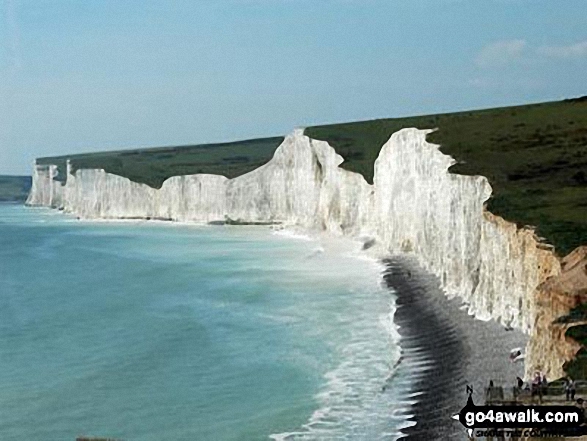
Beachy Head and the Seven Sisters

Rising to 162 meters (530 ft) above sea level, the Beachy Head is the highest chalk sea cliff in Britain. It is located close to the town of Eastbourne in the county of East Sussex, immediately east of the Seven Sisters. The cliff is made of layers of chalk, formed between 65 and 100 million years ago. In the 17th century, it had a reputation for people to attempt suicide, around 20 each year. This figure dropped to seven fatalities in the recent years. (image source)

Not far from Beachy Head and just by the English Channel are the chalk cliffs of the Seven Sisters. They are remnants of dry valleys in the chalk South Downs. They have been featured in movies like Robin Hood: Prince of Thieves and Atonement. (image source)

Kalaupapa Cliffs

The Kalaupapa Cliffs in Hawaii are the highest sea cliffs in the world, dropping about 1,010 meters (3,315 ft) into the Pacific Ocean. They are found on the island of Molokai. The cliffs, like the whole Kalaupapa peninsula, are volcanic in origin, created when lava erupted from the ocean floor near Kauhako Crater. Because of the steep cliffs and surrounding ocean, Kaulapapa cannot be reached by car and visitors can only reach it by a trail. Some workers at the village commute on foot daily on this trail. The cliffs are featured in the movie Jurassic Park III. (image source)
 

The Twelve Apostles

The Twelve Apostles is a collection of eight rock stacks off the shore of the Port Campbell National Park by the Great Ocean Road in Victoria, Australia. The cliffs are approximately 45 meters high. They are made of soft miocene limestone rocks which were gradually eroded by harsh weather conditions. On 2005, a 50-meter tall stack collapsed, leaving eight remaining. The rate of erosion at the base of the limestone pillars is approximately 2 cm per year. The cliffs’ proximity to one another has made the site a popular tourist attraction. (image source)

Cabo Girão

 Cabo Girao stretches 1 km long along the coast of the southern part of Madeira Island in Portugal. it is diamond-shaped and has a height of 560 meters (1,849 ft) to 589 meters (1,932 ft) above sea level.  It is a popular lookout and a starting point for hikers. It is also the location of the Encosta Cabo Girão, a complex of 120 apartments. Another noted feature of the cliff is the Chapel of Nossa Senhora da Fatima which was built in 1974 to replace the much smaller one built in 1931. Located below the cliffs are terraced fields, Fajãs de Cabo Girão, which were accessible only by boats before. In 2003, a cable car was installed on the slope so that farmers can reach the fields. (image source)
 

Étretat

Étretat is a commune in the Seine-Maritime department in the Haute-Normandie region in northern France. It is famous for its cliff, including three natural arches and the pointed “needle”.  Two of the arches can be seen from the town, a third requires a walk at low tide. (image source)

Tōjinbō

Tōjinbō is a collection of surreal, eerie basaltic cliffs on the Sea of Japan in Japan. Stretching 1 km long and rising 70 meters high, it is located in the Fukui Prefecture. The cliffs’ rocks were formed 12 to 13 million years ago due to several volcanic activities, and the cliffs’ shape is influenced by erosion from sea waves. Accordingly, as many as 25 people commit suicide annually on the cliffs. (image source)

Møns Klint

Situated in the eastern coast of the Danish Island of Møn in the Baltic Sea, Møns Klint  is a series of bright chalk cliffs stretching 6 km from the park of Liselund in the north to the lighthouse in the south. Some cliffs rose to 120 meters. Because of the special nature of the chalky soil, the cliffs are home to many rare flora and fauna species like the tall lady orchid, the peregrine falcon, and the large blue butterfly. The cliffs and adjacent park are now protected as a nature reserve. Møns Klint is a famous tourist attraction from across Europe with some 250,000 visitors a year. (image source)
 

Source:

Ten Marvelous Sinkholes in the World

A sink hole is a natural depression or hole in the Earth’s surface which can be several hundreds of meters deep. It is formed either by karst or suffosion processes. The karst  process happens when the carbonate rocks in the ground dissolves and then followed by caving-in. On the other hand, suffosion process happens when loose soil or non-cohesive materials lie on top of a limestone layer containing cracks, joints, or fissure. Rain and surface water will gradually erode these materials and sinkhole formation ensues. A sinkhole is also called as sink, shake hole, swallow hole, swallet, doline, or cenote.

There are many sinkhole formations and they are found worldwide – from remote jungles up to urban areas. Their sizes vary, as well as their forms and occurrence. Here are ten of the largest, most impressive and gorgeous sinkholes in the world.

Xiaozhai Tiankeng

Discovered by specialists in 1994, Xiaozhai Tiankeng is located in the Chongqing Municipality of China. It is the world’s largest and deepest sinkhole. The hole is 626 m long and 537 m wide. It has a depth of 511-662 m. Its area opening is 274,000 m2 and its volume is 119.348 million m3. There is a river underground (inside the sinkhole) that is approximately 8.5 km long.

There is a wide diversity of life at the bottom of the sinkhole. There are 1,285 registered species of plant including the rare gingko and many rare animals like clouded leopard. Recently, fast development in China has transformed the sinkhole into a tourism spot which consequently bring good profit to the rural community. (image source)
 
Dean’s Blue Hole

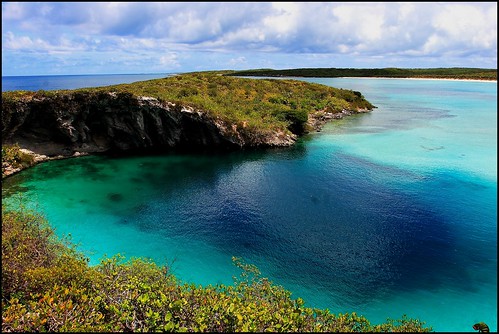
Located in a bay west of Clarence Town on Long Island, Bahamas, Dean’s Blue Hole is the deepest known sinkhole under the sea. Its name is taken from the family name of local landowners in the small bay. The bottom of the blue hole (a term for sinkholes filled with water) is larger with a diameter of around 100 m, making it one of the largest known underwater cave rooms in the world. (image source)

Over the years, the sinkhole has become the site of world-class free-diving sports. Its location is perfect since it is just next to the bank of a calm bay. (image source)


Sima Humboldt

Named after scientist and explorer Alexander von Humboldt, Sima Humboldt (Sima Major) is a huge sinkhole located on the top of the plateau of Sarisariñama tepui in Bolivar State, Venezuela. It is around 314 m deep, with a volume of 21 million m3. Neighboring Sima Humboldt is another marvelous sinkhole – the Sima Martel, or Sima Menor. It is named after legendary speleologist Eduard Martel. The sinkhole is 284 m deep.

Both sinkholes are very unique. They are situated on top of the only forested tepui in the world. A tepui consists of Paleoproterozoan sandstone (quartzite) of Roraima formation and belong to the oldest exposed formations on Earth. Most tepuis do not have forest on their top but the one atop the Sarisariñama tepui is very dense and diverse. Since the walls of both sinkholes are insurmountable, there has developed a unique, small ecosystem inside them. Approximately 1.8 billion years, Sima Humboldt and Sima Martel are some of the oldest sinkholes in the world. (image source)

Great Blue Hole

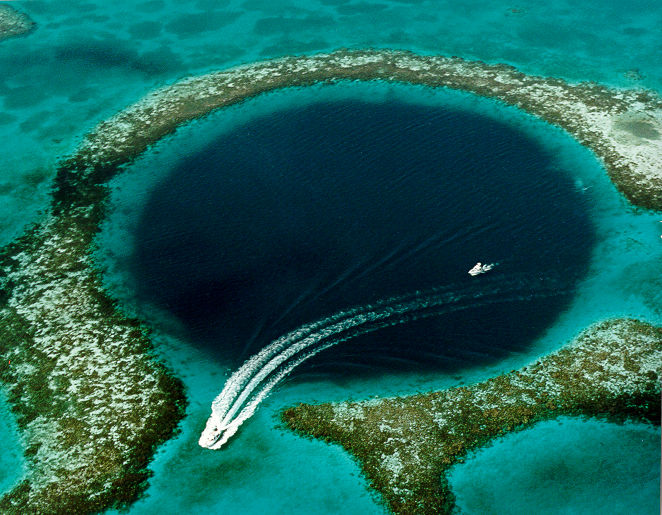
Another impressive blue hole, the Great Blue Hole located off the coast of Belize in nearly perfectly round sinkhole. Its diameter is approximately 318 m, and its depth is at most 124 m. The sinkhole lies near the center of Lighthouse Reef which rises above the sea when the tide is low. There are no waves or currents inside the blue hole at depths of 18-20 m. However, the water suddenly turns brownish or enriched with hydrogen sulfide at 90-101 m deep. At the bottom of the Great Blue Hole, no life exists and only large pieces of limestone and sediments can be found. (image source)

The Great Blue Hole is a part of the larger Belize Barrier Reef Reserve System which is a World Heritage Site of UNESCO (United Nations Educational, Scientific, and Cultural Organization).

El Zacatón

Known as the deepest known water-filled sinkhole in the world, El Zacatón belongs to the Zacatón system – a group of unusual karst feature located in Aldama Municipality in the northeastern state of Tamaulipas, Mexico. It has a depth of 339 m. The name of the sinkhole is derived from the free-floating islands of zacate grass which drift around the lake. These islands are formed from precipitated calcium carbonate and overgrown with the grass. (image source)

Water of El Zacatón is 29-30OC warm. It is slightly acidic at 6.9 pH level. El Zacatón is also unusual with its unique ecosystem. On rocks walls at 115-270 m depth, at least 9 new classes of microbes have been found. (image source)

El Zacatón is an important diving site with several scuba diving world records set there.

Crveno Jezero

One of the largest sinkholes in the world, Crveno Jezero is located near the city of Imotski, Croatia. It is also called as Red Lake due to the reddish-brown color (caused by iron oxides) of the surrounding cliffs. It is approximately 530 m deep, with a width of 450-500 m and volume of 25-30 million m3. The diameter of the lake at the bottom of the sinkhole is around 200 m with a depth that runs from 280-290 m. Three small caves have been found near the water level of the lake. (image source)

Crveno Jezero contains several endemic species of organisms. One of which is the 12-cm long fish Delminichthys adspersus. This fish require extremely clean water present in the lake and are highly endangered.
Cave of Swallows

The Cave of Swallows, Sótano de las Golondrinas in Spanish, is an open air cave in the Municipaity of Aquismon, San Louis Potosi, Mexico. It owes its name from the myriad birds, specifically white-collared swifts, living on the holes on its cave walls. Entrance of the sinkhole is elliptical, measuring 49 by 62 m wide. But deep inside, it becomes much wider, around 303 by 134 m large at the bottom. The floor of the cave is a 333-m freefall drop from the lowest side of the opening, or 370-m drop from the highest side, making it the largest known cave shaft in the world. Because of its enormous size, the sinkhole is a popular extreme sports destination. Climbing, rappelling, and base jumping are just some of the sports undertaken there. (image source)

Sótano del Barro

Sótano del Barro, or “Cellar of Clay”, is located in Sierra Gorda mountains in the Arroyo Seo Municipality of Mexico. It has nearly vertical walls and rather looks like an elongated hole that is 455 m deep. The sinkhole houses the largest population of Mexican subspecies of military macaws. Flocks of these birds leave the cave early in the morning and return in evening. (image source)

Sótano del Barro is located amidst primeval tropical forest. At the bottom of its abyss, a unique ecosystem of ferns, shrubs, and even trees thrive. Because of this, it has been proposed as a UNESCO World Heritage Site. (image source)


Kingsley Lake

Kingsley Lake is an almost perfect circular lake about 2,000 acres in North Central Florida. It is believed to be the oldest and highest lake in Florida. The lake is only 27 m deep and is a very stable lake. Its shape is nearly circular that it is tagged as Silver Dollar Lake. Kingsley Lake is famous for its clear waters, water skiing, and fishing. (image source)

Blue Hole

The Blue Hole is an underwater sinkhole located on east of Sinai, north of Dahab, Egypt on the coast of the Red Sea. It has a depth of around 130 m. The Blue Hole has a 6-m deep opening called “the saddle” which opens out to the sea. There is also a 26-m long tunnel, known as “the arch”, of which its top lies at a depth of 56 m. The Blue Hole has been named as the “World’s Most Dangerous Dive Site” and “Diver’s Cemetery” because of the number of diving fatalities occurring there. Deaths are usually due to the diver’s futile attempt to find the tunnel through “the arch.” (image source)

Based on their depths, here are the ten largest sinkholes in the world:

  1. Xiaozhai tiankeng – China, Chongqing Municipality (662 m)
  2. Dashiwei tiankeng – China, Guangxi (613 m)
  3. Crveno Jezero – Red Lake – Croatia, Split-Dalmatia (530 m)
  4. Minye Sinkhole and Cave – Papua New Guinea, East New Britain (510 m)
  5. Haolong tiankeng – China, Guangxi (509 m)
  6. Kavakuna sinkhole – Papua New Guinea, East New Britain (480 m)
  7. Taipingmiao tiankeng – China, Chongqing Municipality (420 m)
  8. Sotano del Barro – Mexico, Queretaro (410 m)
  9. Xiashiyuan tiankeng – China, Chongqing Municipality (373 m)
  10. Daluodang tiankeng – China, Chongqing Municipality (372m)
Sources:


Related Posts Plugin for WordPress, Blogger...