Showing posts with label Environment. Show all posts

Ten Major Disadvantages of Geothermal Energy


Geothermal energy is one of the largest sources of electrical power in the world. The USA, Philippines and Indonesia are the three largest producers of geothermal electricity. The science behind this technology is simple – we use the heat beneath the ground either by extracting the steam produced underground or by pumping water into the heat source, thereby steam and bringing it up to be used. Inside the plant, the steam conveyed through the pipes is used to turn generator which eventually produces electricity.

This type of energy is renewable as the heat underground does not get exhausted. It sounds promising, but there are certain disadvantages with its use. Here are the ten major drawbacks of geothermal energy:  

1. Location. Geothermal systems are site specific. Though hot rock reserves are found all over the world, the technology is very much applicable only to places located near the Pacific Ring of Fire, volcanic areas, or spots near tectonic plate boundaries. Hot rock reserves in these places are shallower and hence, easier to access than other sites.


2. Reachable reserves. Aside from their depth with respect to ground surface, the type of rock above the reserve is also important. It must be a type that can be easily drilled through.


Image courtesy of Conserve Energy Future.

Critically Endangered Albatross


The International Union for Conservation of Nature or IUCN has listed several flora and fauna species which are classified as critically endangered. This status is given to animals facing extremely threat of extinction. Some of these species have not been cited for a long time.  For others, there are no valid documents for their continued existence or possible extinction. The most common threats for these animals are habitat destruction and human activity.
Among the animals identified by IUCN as under critically endangered status are four species of albatross. Here are the basic descriptions of these birds.

Amsterdam Albatross. This is a huge albatross endemic to the Amsterdam Island in the southern Indian Ocean. Unlike other albatrosses which are usually white, the Amsterdam Albatross has a brown plumage. Its weighs 4.8 – 6 kg (11-18 lb) and possesses a wingspan of 280 – 340 cm (110-130 in). The adult bird has chocolate brown upper parts, and is white on its face mask, throat, lower breast, and belly. It has a broad brown breast band along with brown undertail coverts. Its pink bill has a dark tip and dark cutting edges, and finally, its underwings are white except for the dark tip and the dark leading edge.

Solar Home Heating: Concepts and Methods


Solar home heating systems are gaining popularity nowadays despite its high initial investment. These systems basically utilize solar radiation to provide space heating. This means that power from electrical equipment for heating space is eliminated. There are two general systems of solar space heating based on how heat is captured. These are the passive and active solar heating system.
Passive solar heating. This system requires no equipment to capture solar radiation. Its concept is similar to heat building up inside your car when it is left parked under the sun. Heat naturally accumulates inside the space. In this design, windows, walls, and floors are made to collect, store, and distribute solar energy in the form of heat in the winter and reject solar heat in the summer. It does not use mechanical and electrical devices. Passive solar buildings aim to maintain interior thermal comfort throughout the sun’s daily and annual cycles while reducing the requirement for active heating system.

Ten Foods for a Healthier Kidney

The kidney is one of the vital organs in the body. It serves many essential regulatory roles such as control of electrolyte levels, maintenance of acid-base balance, and even regulation of blood pressure. The kidney is also the body’s natural filter, removing wastes such as urea and uranium.

With the critical functions that kidney plays, it is imperative to keep this organ in a good health. Many parts of the human’s diet pose threats to the kidney. Yet, certain parts may also aid in protecting the kidney from ailments and from malfunctioning. Read the rest of the article >>>

Nine Critically Endangered Hummingbirds

Hummingbirds are some of the smallest birds in the world. In fact, the smallest bird species is the Bee Hummingbird which measures 5 cm. Comprising the family Trochilidae, hummingbirds are also the only group of birds known to fly backwards. They can float in mid-air by rapidly flapping their wings at 12-90 times per second. This rapid wing beats create hum, thus the name.

Those are some of the amazing fun facts about this marvelous bird. However, a sad truth about hummingbirds is that some species have been listed as Critically Endangered by the International Union for Conservation of Nature or IUCN. This means that these birds are at extreme risk of facing extinction, way beyond being endangered. Here are the nine species of hummingbirds identified as Critically Endangered.

Black-breasted Puffleg

Measuring only 8.5 cm in length, the Black-breasted Puffleg is found only in Ecuador, specifically on the Northwestern slopes of the Pichincha volcano. This little bird prefers high altitudes, spending the rainy season above 10,000 feet and the rest of the year — when certain preferred plants flower — residing between 9,006 and 10,000 feet. It has entirely blackish upperparts, dark blue uppertail-coverts and blackish underparts, with violet-blue throat and undertail-coverts. (image source)

This species is suspected to have suffered ongoing declines at a rate of 10-19% over ten years, owing to widespread and continuing habitat loss within its range. Presently, its population is made up of no more than 250 individuals.

On June 23, 2005, the bird was adopted as the emblem of the city of Quito.

Nine Critically Endangered Pigeons and Doves

Doves and pigeons belong to the same family of birds called Columbidae within the order Columbiformes. Generally, they have stout bodies with short necks. They have slender bills with a fleshy operculum or swelling. There are around 300 species of this bird. The term “dove” is most commonly used for smaller species and “pigeon” for larger ones.

These birds are some of the most common to humans as many of their populations are found in cities and human dwellings. Yet, some of their species faces extreme risk of extinction, known as being critically endangered. The IUCN or International Union for Conservation of Nature has identified nine species of these birds under this category. Here are the descriptions of the nine critically endangered pigeons and doves.

Purple-winged Ground Dove

The purple-winged ground dove is native to Atlantic forests. They are found near bamboo areas in south-eastern Brazil, far eastern Paraguay, and northern-eastern Argentina. It is approximately 19-23 cm in length. The male has slate-blue plumage which is paler below. It has whitish face and belly. The female, on the other hand, is matt brown with paler belly and throat. (image source)

Threats to the bird include habitat loss and wild bird trade. Currently, its population is estimated to be less than 250 individuals.


Blue-eyed Ground Dove

Endemic to Brazil, the blue-eyed ground dove lives in the subtropical or tropical dry lowland grasslands. It is 15.5 cm tall. It has bright brown head, neck, breast, rump, and wings. It has dark blue spots and pink feet. Its iris is blue, hence its name. The bird is threatened by habitat loss. Population is estimated from 50-249 individuals. (image source)

Silvery Pigeon

Also known as silvery wood-pigeon or grey wood-pigeon, the silvery pigeon was first thought to be extinct until photographs of it were taken in 2008 near Masokut Island in Indonesia. It lives in mangrove forests and other woodlands in the low-lying offshore islands and adjacent coastal regions. Its plumage is pale silvery grey, with black remiges (or flight feathers) and ends of the tail feathers.(image source)

Deforestation, especially removal of mangrove forests, and introduction of alien predators are thought to have threatened this bird. There is no exact estimate population of silvery pigeons.

Polynesian Ground Dove

As its name suggests, the Polynesian ground dove is native to French Polynesia. Its natural habitats are subtropical or tropical dry forests, subtropical or tropical dry shrubland, plantations and rural gardens. It is 25 cm tall, medium-sized, and short-tailed. It has mostly dark grey plumage with white throat, chest, forehead, and eyebrow. (image source)

It has a very small population, fragmented into extremely small subpopulations, on tiny wooded islets. Its extinction from several islands indicates an overall decline, which is likely to continue owing to predation by rats and cats, habitat loss and deterioration, and natural disasters such as hurricanes and severe storms.

Negros Bleeding-heart

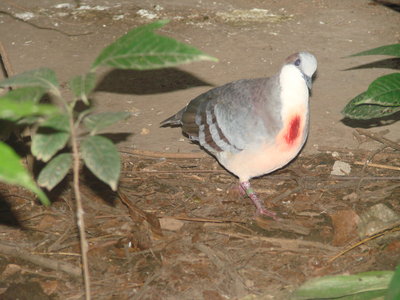
The Negros bleeding-heart is endemic to the Philippines, found particularly on the tropical rainforests in the islands of Negros and Panay. It is 25-30 cm tall. It is a ground-feeder but roosts and nests on bushes and vines. The name “bleeding-heart” comes from the patch of red feathers found on the breast of the bird. It is grey above and paler buff below. (image source)

The bird has an extremely small, severely fragmented population. Hunting and habitat loss have caused decline in its population.

Sulu Bleeding-heart

The Sulu bleeding-heart is another critically endangered specie of ground dove endemic to the Philippines. It is approximately 30 cm tall. It is medium-sized and short-tailed, with bright orange central patch to otherwise white breast. It has dark grey forehead that merges into iridescent green nape and upper mantle. (image source)

The bird is known from two specimens collected in the Sulu Archipelago in 1891, and has not been recorded with certainty since.  It may have declined severely through extensive logging and habitat destruction, compounded by hunting and trapping. Since there are reports of local sightings in 1995, it is unlikely to be extinct. However, any remaining population is likely to be tiny.

Mindoro Bleeding-heart

The Mindoro  bleeding-heart is a type of ground dove native to Mindoro, Philippines. Like other birds in the Gallicolumba family, it has a bright orange (or red) central patch to otherwise white underpants. It is also medium-sized and short-tailed. It has dark grey crown, nape, upper mantle and breast sides. Its legs are red. (image source)

The bird has an extremely small, severely fragmented population which is undergoing a continuing decline owing to lowland forest destruction, combined with hunting and trade.

Grenada Dove

Originally known as the Pea dove or Well’s dove, the Granda Dove is a medium-sized New World tropical dive, endemic to the island of Grenada in the Lesser Antilles. It has white throat. Its face and forehead is pale pink to dull brown on crown and nape. Its neck and upper  breast is pink-buff fading to white on lower breast, belly and undertail coverts. (image source)

Very little is known about the bird. The total population declined by approximately 50% between 1987-1990, numbering an estimated 100 individuals in 1998, and increasing to an estimated 180 individuals by 2003/2004. Threats to this bird are human activity, habitat loss, introduction of alien predators, and hunting.

Negros Fruit Dove

The Negros Fruit Dove in another critically endangered dove specie found on the islands of Negros, Philippines. its natural habitat is subtropical or tropical moist lowland forests. It is only known by a single female specimen. It is a very small (around 16.5 cm) with vivid dark green fruit-dove. The sole specimen is characterized by extensive, broad, yellow eye-ring, ashy-grey forehead and grayish-white throat. (image source)

Actually, this bird may or may not be extinct since there have been no sightings of it since 1953. However, it may remain extant, given that there was an unconfirmed report in 2002. Further surveys are required on Panay where it may conceivably occur. Any remaining population is likely to be tiny, and undergoing a continuing decline owing to hunting and extensive habitat destruction.


Ten Major Advantages of Briquettes


Fuel has always been an indispensible need of man. Whether from developed or third world countries, people around the world need fuel for everyday living. In preparing our basic necessities like food and clean water, we need fuel. Usually, we rely on electricity and fossil fuel (like liquefied petroleum gas and kerosene) for our energy need.  Some nationalities use firewood and charcoal. However, there are other resources which have more advantages and benefits that these conventional sources. One such fuel is the briquette.

Briquettes are flammable blocks of matter used as fuel. They are made from extruded or compressed shredded combustible materials. A binding agent like starch may be necessary to hold the materials together, though pressure may at times be enough. Some of the common materials used as briquettes are charcoal fines, mineral char, sawdust, chaff from rice, peanut and other crops, peat, and any biomass materials.

So why do we have to used briquettes instead of firewood, charcoal, or electricity? What are their advantages over them? Well, here are ten of the major benefits derived from the utilization of briquettes as fuel.

1. Concentrated. Since briquettes are created from compressing combustible materials, they are denser, harder, and more compact. They have high specific density (1200kg/m3) and bulk density (800kg/m3) compared to 60 to 180 kg/m3 of loose bio mass. Thus, they offer a more concentrated form of energy than firewood or charcoal.

2. Slow-burning. The compression process allows the briquettes to burn for a lot longer than if it was loose in its original condition.

3. More efficient. Along with the compactness of the briquettes is the increase in heating value. Briquettes can relatively produce more intense heat than other fuel. They have a higher practical thermal value and much lower ash content (2-10% compare to 20-40% in coal). In fact, they are 40% more efficient, as well as hotter and longer lasting than firewood. This greater efficiency can be attributed to their low moisture and density.

4. Smokeless. This is a unique property of briquettes. Using them creates no smoke, soot, or carbon deposits. Depending on the base material, they produce no or little fly ash. Further, briquettes do not emit gases or any toxic chemicals like sulfur.

5. Availability. Biomass is the main component in producing briquettes. So where do we get this biomass? Look around you, and there are loads of biomass materials here, there, and everywhere.

6. Easy to make. There are presently commercial briquettes sold in the market. However, ordinary households can produce briquettes. You must only have a stock of combustible matter, a binder, and a molder to shape the briquettes.

7. Easily stored. The size and shape of briquettes make them easily be stored. We can readily pile them in several heaps because of their fun shapes like cubical, spherical, cylindrical, or rectangular blocks. They are likewise clean to handle and be packed into bags.

8. Easily transported. Compacting biomass waste into briquettes reduces the volume by 10 times, making it much easier to store and transport than loose biomass waste. Considering their shape, size, and density, briquettes are excellent for long distance transport. Likewise, loading and unloading cost are much less and are done easier.

9. Cheaper. Since briquettes can be domestically made from plants and animal wastes, they are consequently less expensive to produce, and thereby sold at lower prices.

10. Renewable. Briquettes make use of organic materials which are common and renewable. Hence, we are ensured of the sustainability of such fuel source.
Related Posts Plugin for WordPress, Blogger...